
Having a hornet nest treated and taken down costs $150 to $400 on the price we publish for wasp nest removal in Barrie, for a single nest that can be reached. Where the nest hangs decides where in that band it lands. A grey paper ball on a shrub beside the front step sits at the bottom. The same ball under a second-storey eave costs ladder time. A colony hidden in a wall cavity or attic sits at the top. And a nest well away from where anyone walks may cost nothing at all, because it can be left for the frost.
The species name does not move the price on our page. The location does.
Five places a hornet nest turns up, and what each one costs
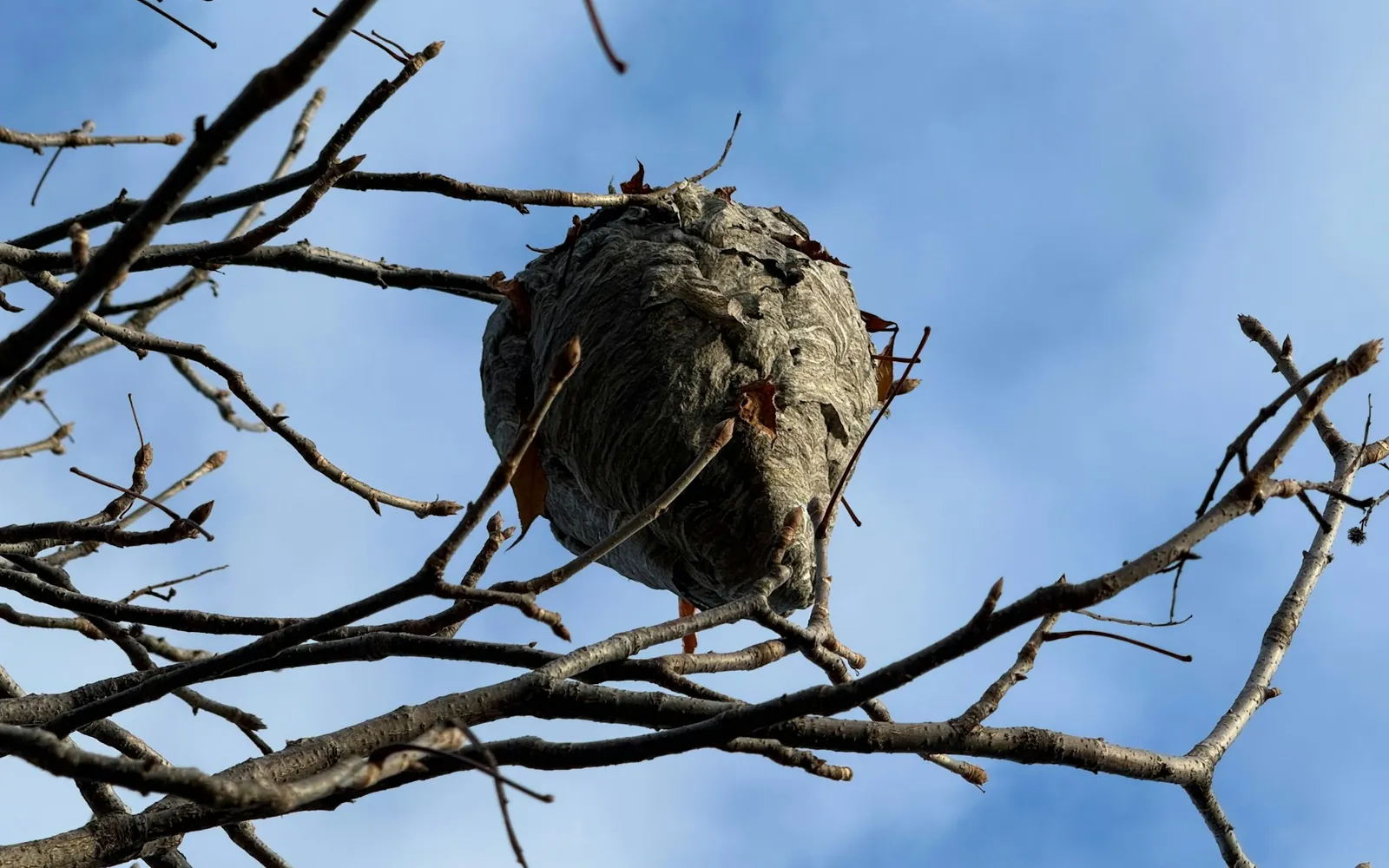
Most of what people around Barrie call a hornet nest is the grey ball built by the bald-faced hornet. Iowa State says it is usually fixed to a tree branch in a wooded area, though shrubs, poles and the siding of a house also carry them. Ontario’s true hornet, the European hornet, hides its nest instead: the University of Maryland names concealed sites such as hollow trees, sheds and barns, and the voids inside walls and attics. That split is most of the pricing.
| Where you find it | Where it lands on $150 to $400 | Why |
|---|---|---|
| Grey ball on a shrub, a fence or low siding, reachable from the ground | Base of the band | No ladder, and the whole nest is in view |
| Grey ball under a second-storey eave or high on the siding | Mid-band | Ladder time is the difference |
| Brown nest you cannot see, hornets coming and going from a gap in a wall or a roof vent | Top of the band | A colony in a wall or attic is treated and then monitored |
| Grey ball up a back-lot tree, with nobody walking under it | Nothing, if you leave it | Iowa State’s advice is to leave nests away from people undisturbed |
| Grey ball spotted once the leaves drop, after the hard frosts | Nothing | The colony is dead and the nest will not be used again |
A second nest found on the same visit adds a small amount per nest, according to the price table on our service page. So mention a second nest when you first ask.
What the price covers
The band on our page is for a nest treated and removed. Those are two steps, and they do not always happen in the same minute.
The treatment goes into the nest when the colony is home. Iowa State’s method for bald-faced hornets is to work at night if possible, when the workers are least active and the most of them are inside, spraying into the entrance hole first and then soaking the nest. Its next instruction is the one homeowners do not expect: do not take the nest down until all the wasps are dead. Iowa State says that can take a day or two, because some foraging workers were out when the nest was treated.
So hornets flying around the spot the next afternoon do not mean the job failed. They are foragers that were away during the treatment and came back to it, and Iowa State expects them to be gone within that day or two.
For the brown hidden nest in a wall, the order matters more. The entry gap gets sealed only after the activity inside has stopped. Sealed too soon, the colony looks for another way out, and our service page explains why that way is often into the house.
The hornet nest that costs nothing
Two of the five rows in the table are free.
Health Canada’s advice is that a nest which does not present a health hazard is best left until November or December, then taken down once it is abandoned. Iowa State puts it more plainly for bald-faced hornets: a nest by a walkway or a doorway is worth controlling, and a nest away from human activity should be left alone.
Around Barrie the deadline is the first hard frost. Hard frost ends the colony, the new queens spend the winter elsewhere, and each starts a fresh nest in the spring. A grey ball high in a maple at the back of a Midhurst lot can be watched from the kitchen window until then. The same ball over a back door in August cannot. The longer case for waiting on wasp nest removal in Barrie sets out which nests can sit and which cannot.
An empty nest in winter is a different case again. Per the University of Maryland, every social wasp colony lasts a single year and its paper is not reoccupied. Nobody needs to be paid to remove it.
What raises the number, and what does not
Things that move a hornet nest up the band:
- Height. A second storey means a ladder, and our price table puts that at mid-band.
- Concealment. Hornets going in and out of a soffit gap or a roof vent mean a colony inside the structure. That is the top of the band, because it is treated and then monitored.
- More than one nest. Each extra nest on the same visit adds a small amount.
Things that do not:
- The name. A bald-faced hornet nest is not priced above a yellowjacket or paper wasp nest at the same height. Iowa State places the bald-faced hornet in the yellowjacket family.
- The size of the grey ball, on its own. A large nest at ground level is still a ground-level job.
Doing it yourself instead
Doing it yourself saves the fee, and Health Canada does accept that a properly protected homeowner may take a nest down. It also recommends professional help, and Iowa State warns that hornets usually attack anyone who comes close to the nest.
A grey ball within reach of a person standing on the lawn, in a spot you can back away from, with no sting allergy in the household, is the case where it is worth thinking about. A ball over your head on a ladder is not. The three questions that settle whether you can remove a wasp nest yourself apply to a hornet nest unchanged.
Before you ask for a price
The quickest way to a firm wasp removal quote is to describe the nest so the job can be read from the description:
- Shape and colour. A grey ball you can see, or a brown nest you cannot see with hornets using a gap.
- Height. Ground level, first storey, or second storey.
- What is under it. An entrance, a path, the deck, the driveway, or open ground.
- How many. Walk the property once from a distance. A second nest is cheaper on the same visit.
- A photo, zoomed in from well back. Do not walk up to it for a better shot.
If the nest is in one of the two free rows, leave it for the frost. If it is not, send the photo and the four notes when you ask for a Barrie pest control quote.