
Sometimes you can. Health Canada’s own advice is that a homeowner with enough protection can remove a nest, and that professional help is still recommended. The nest decides which advice applies. A small open paper wasp comb you can reach standing on the ground, found early, with nobody in the house who reacts badly to stings, is a reasonable job to do yourself after dark. A nest you cannot see, a nest you need a ladder for, or anyone with a sting allergy is a job to hand over.
There is a third answer that the question leaves out: the nest may not need removing at all.
Three questions before you buy a can
Can you reach it with both feet on the ground? A nest under a deck railing, in a barbecue, or on a low shrub, yes. A nest in a second-storey soffit, no. Health Canada’s warning is about the risk of attack by a large group of wasps, and that risk is worse on a ladder, where you cannot step back.
Can you see the whole nest? An open comb shows you everything: the cells, the stalk, the wasps standing on it. A hole in the lawn or a gap in the siding with steady traffic shows you only the door. UC IPM calls nest removal for ground and cavity yellowjackets not practical, because the nest can sit well back from the entrance and a spray may never reach it. If all you can see is a hole, you cannot tell how big the colony behind it is.
Does anyone in the house react badly to stings? Health Canada tells anyone whose reaction includes unusual swelling, itching, dizziness or shortness of breath to get medical attention right away. If that describes someone in the household, the answer to the whole question is no, whatever the nest looks like.
Timing sits behind all three. Health Canada notes that it is easier to discourage a single queen from settling near the house in early summer than to deal with a full-sized nest later. A comb the size of a coin on a June porch light is not the same job as the same nest in late August.
If all three answers are yes
These are the steps the government and extension guides give. They are not a promise that nobody gets stung. UC IPM is blunt about it: even after dark, and even with a can that shoots a stream up to 20 feet, stinging incidents are likely.
- Pick the product by its label. UC IPM specifies an aerosol labelled for wasp and hornet nests. Health Canada adds the check that matters in a Canadian store: a PCP number on the label, which shows the product is approved by Health Canada. Check for the number before you check the price.
- Go after nightfall. Health Canada recommends spraying after dark because wasps are less active, and Iowa State notes that the workers are all at the nest then.
- Keep the light off the nest. Health Canada says a light aimed at the nest alarms the wasps. It suggests a red filter over the flashlight instead.
- Cover everything. UC IPM lists clothing over the whole body, gloves, a veil over the face and eye protection. Health Canada names a head net.
- Stand at the can’s range, not closer. Iowa State says these cans shoot the insecticide several feet. Read yours and stay at that distance.
- Take the comb down afterward. Health Canada describes enclosing a small nest in a plastic bag, detaching the single stalk, and putting the bagged nest in a freezer for at least 48 hours.
Know your way back to the door before you start, and leave the area once the can is empty.
The day after
Expect wasps. UC IPM warns that partly poisoned, agitated wasps can be met some distance from the entrance the day after a treatment. Keep children and pets off that part of the yard for the day.
The colony will not rebuild in the nest you removed, because the University of Maryland records that wasps do not reuse old nests. The site is another matter. A sheltered corner that suited one queen can suit another next spring, which is why the entry point matters as much as the nest.
What not to do
- Do not plug the hole. Iowa State’s rule is not to plug a nest opening in a house wall until all activity inside has stopped. A colony sealed into a soffit or wall looks for another way out.
- Do not spray a hidden nest from a ladder. That combines the two conditions that make the job a poor one to do yourself.
- Do not mow over a hole with traffic. Health Canada advises against even walking barefoot on lawns in late summer, when wasps are more abundant and active. Mow around the spot until the nest is dealt with.
- Do not treat bees. Honeybees in a wall are a job for a beekeeper, not a spray can.
The nest you can leave alone
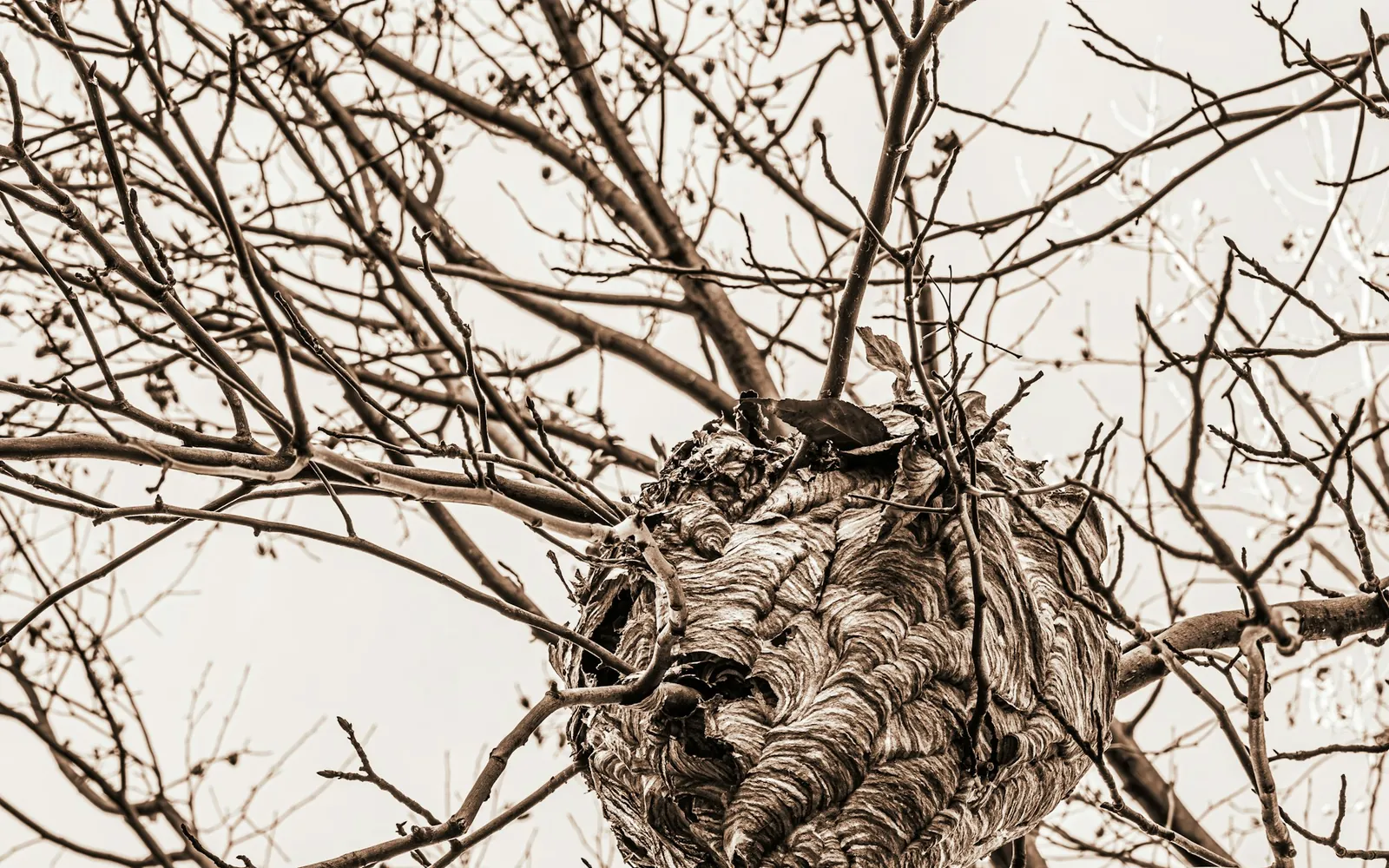
Health Canada’s first option for a nest that is not a health hazard is to leave it until November or December and take it down once it is abandoned, with little risk. In Simcoe County that means waiting for the first hard frost. A grey ball in a maple well away from the house, or a comb inside a shed door that stays shut, can fit that description. The question of whether wasp nest removal in Barrie can wait for the frost is worth reading before you buy anything.
Is the spray legal in Ontario?
Ontario’s cosmetic pesticide rules, set under the Pesticides Act and Ontario Regulation 63/09, limit what homeowners can use on lawns, gardens, patios and driveways. The same provincial page says you can also use pesticides to protect health or safety from pests such as wasps. A labelled wasp spray on a nest beside your door is inside that rule. The label still governs how you use it.
When to hand it over
A hidden nest, a nest overhead, a colony inside a wall, or a sting allergy in the house: those are the cases for wasp nest removal around Barrie, including soffit and in-wall colonies where the order of treating and sealing matters.
Height and access set the hornet nest removal cost, and the Barrie pest control cost table lays out the bands by job. If you have looked at the nest from a safe distance and taken a photo, request a Barrie pest control quote and send it with the note of where the nest sits.